
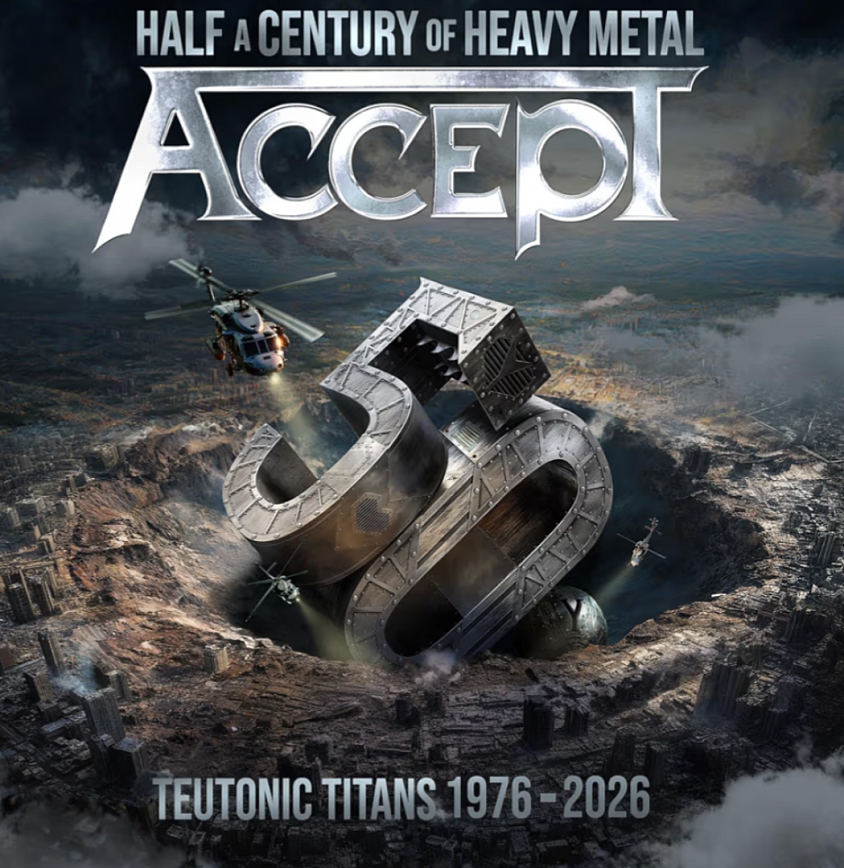
Accept release their incredible new album Teutonic Titans - Autumn 2026
"We just became more independent and that’s exactly what people liked about us”
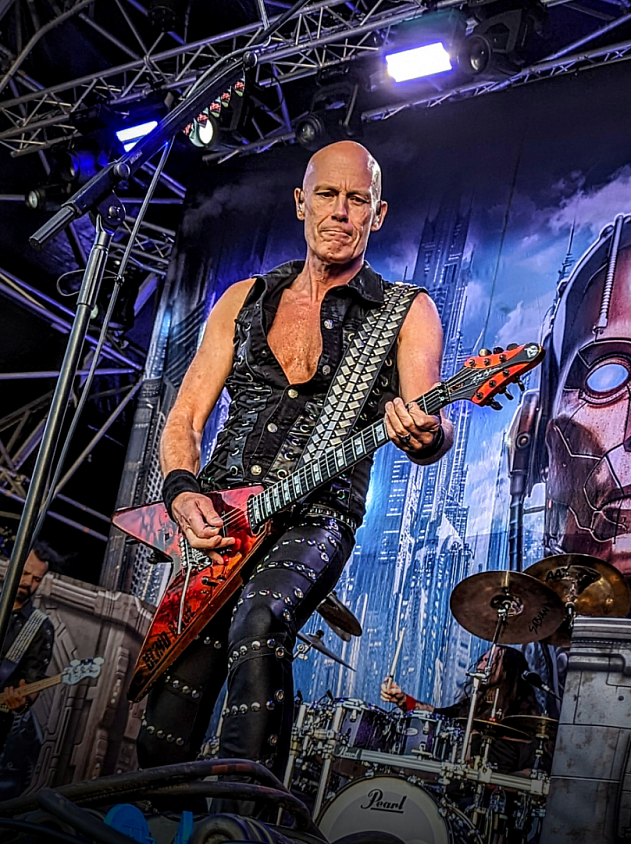
Wolf Hoffmann
Few bands can claim to have played such a significant role in shaping heavy metal as Accept. For almost half a century, the German giants have forged a sound that has influenced generations of musicians around the world, while songs such as Balls to the Wall, Metal Heart, Fast as a Shark and Restless and Wild have become firmly established in the heavy metal canon. Now, as Accept celebrate 50 years of heavy metal, guitarist Wolf Hoffmann is looking back at that extraordinary history from a very different perspective.
Rather than simply revisiting the band's past, Teutonic Titans brings together 19 songs from the Accept catalogue and gives them a new lease of life through an extraordinary collection of guest musicians.
The album features contributions from some of the biggest names in rock and metal, including Judas Priest's Rob Halford and Metallica's Kirk Hammett, alongside musicians including Joel Hoekstra and others who have their own personal connections with Accept's music.
For Hoffmann, the idea wasn't simply to reproduce some of the band's most famous songs. Instead, he wanted to discover what could happen when musicians who had been influenced by Accept were given the opportunity to put their own stamp on the material.
“I always believe if you do a remake of a song, what’s the point in doing it exactly like the original?” he explains. “What’s the point?”
That philosophy became central to Teutonic Titans, with Hoffmann encouraging each contributor to respect the original recordings while bringing something of their own musical identity to them.
“We told everybody, ‘Be respectful of the original and listen to it, don’t go crazy. Don’t turn it into something that it was never meant to be. But give it your own stamp as much as possible.’”
And, according to Hoffmann, the response from the musicians exceeded even his expectations.
“I was super impressed how careful everybody was and how respectful and how much effort they put into it. Nobody just sort of half-assed it or just phoned it in. Everybody delivered mind-blowing stuff.”
There is also something particularly satisfying about the concept given the influence Accept themselves have had on the musicians involved.
Hoffmann recalls countless conversations over the years with artists telling him that hearing Accept in the early 1980s changed their lives, with some even saying that their first heavy metal concert had been an Accept show.
“That’s why we picked a lot of songs from that time frame,” he says. “There’s all these musicians that I met along the way who told me, ‘When I listened to Restless and Wild in ’83 or Balls to the Wall in ’84 or whatever, it changed my life. And I became a musician because of you.’”
That makes the album more than simply a celebration of Accept's back catalogue. It becomes something of a musical full circle.
And for Hoffmann, there is a certain irony in just how influential Accept eventually became.
The band emerged from Germany at a time when many of their own heroes came from Britain and America. While the New Wave of British Heavy Metal was taking shape, Accept found themselves on the outside of that particular club.
“We were almost the odd one from Germany,” Hoffmann reflects. “We were part of the new wave but not part of the British part. So we were like, ‘Oh, it’s a little outside stepchild of the whole club.’”
Rather than allowing that to hold them back, however, Accept increasingly followed their own instincts.
“We never sat at the same table back in those days,” he says. “So I don’t know if we developed our own style and just said, ‘We’re just gonna do what we like doing. We’re not really gonna care so much anymore about what other people say we should do.’”
That independence, Hoffmann believes, ultimately became one of the things that connected Accept with their audience.
“We just became more independent and that is exactly what a lot of people liked about us. But did we know that? No. It was just a gut feeling and just something that happened, if you went by coincidence.”
Half a century later, that instinct remains at the heart of Accept.
And while Teutonic Titans looks backwards, it is also a reminder that the band's music continues to evolve, inspire and find new audiences.
For Hoffmann, releasing an album may not carry quite the same commercial meaning it did during the band's heyday, but the emotional significance of putting new music into the world hasn't disappeared.
“I’m a bit anxious to get it finally out to the public,” he admits. “For some reason, the pre-run time for this has been quite long. I felt like the first thing was maybe released in May and now here we are in August. And I want this thing out in the hands of people.”
That nervousness, he says, is still very real.
“It’s as exciting artistically and you’re nervous as an artist because you’ve written all these songs, or you’ve put all that time into it. So you’re anxious to see what people will, how they feel about it.”
But the music industry has changed dramatically since Accept's early days.
“Back in the day, an album was everything,” Hoffmann explains. “If the album sold well, that was what we measured everything by. In the eighties, it was all, ‘Oh man, he sold five million, three million, two million,’ whatever it was. It was all about the numbers, how many albums you sell.”
Even touring, he points out, was once largely designed to support album sales.
“That whole thing has shifted completely. An album now is important, but it doesn’t have the same meaning just because people don’t pay for music anymore and it’s almost like a free commodity that you release along the way of everything else that you do.”
Artistically, though, it remains hugely important.
And Teutonic Titans has given Hoffmann an opportunity to revisit some familiar territory while also shining a light on parts of Accept's history that have perhaps been overlooked.
The track selection includes obvious classics such as Balls to the Wall, Metal Heart and Fast, but Hoffmann was equally determined to bring some deeper cuts back into the spotlight.
“There was a bunch of them that we had to do,” he says. “But then it came to these other tracks. I wanted to make sure we played some deep cuts, some songs we haven’t even played live in a long time.”
Accept have often concentrated on their current albums and the highlights from their celebrated 1980s period, but Hoffmann saw the project as a chance to revisit some of those less frequently heard songs.
“I thought, let’s do some of those because I always felt they were a little bit neglected.”
One of the most fascinating aspects of the album is the calibre of musicians who accepted Hoffmann's invitation.
Some were already friends or collaborators, while others were approached simply to see whether they would be interested.
“I knew some people because we meet along the way, you have a phone book,” he jokes. “Some people I knew would probably do it. Some of them have already worked with us in the past, like Michael Cardelloni or Joel Hoekstra.”
Others were much less certain.
“Some others I didn’t really know and thought, ‘Let’s just ask him.’ And to my huge surprise, everybody said yes practically.”
Among those guests was Metallica guitarist Kirk Hammett, who Hoffmann says had made his admiration for Accept clear.
“I knew he was a bit of an Accept fan because he told me at one point, you know, he said, ‘Oh man, I listen to your stuff.’ And actually the whole band has.”
Hoffmann admits that until the musicians actually committed to the project, there was no guarantee that the ambitious idea would work.
“You just send out the feelers and you send out emails and then you see what happens. We didn’t really know how many people would say yes or no. But everybody did.”
Another particularly personal connection is Joel Hoekstra, whose long association with Hoffmann has seen him become something of an extended member of the Accept family.
Hoffmann's affection for the guitarist is obvious.
“If you heard his solo in Metal Heart, it’s fucking mind-blowing,” he says. “I’d class him as a friend. I’ve known Joe for about 15 years, a long, long time.”
For Hoffmann, Hoekstra is simply one of those exceptional musicians whose talent is impossible to overlook.
“He’s just the best and, for me, one of the most gifted guitarists.”
Whether there will be another opportunity to work together remains uncertain, but Hoffmann clearly isn't ruling it out.
“I wish we could do more together one day, but he’s always in other projects, like Trans-Siberian Orchestra. So we’ll see. Maybe we’ll have him back one day. I don’t know.”
Ultimately, Teutonic Titans is a celebration of the journey Accept have taken since those early days in Germany, but it is also a celebration of the musicians who were inspired by that journey.
For Wolf Hoffmann, the fact that Accept's music went on to influence so many other artists was never part of some grand masterplan.
“We never set out to do this,” he says.
They simply followed their instincts, developed their own identity and refused to worry too much about whether they fitted neatly into somebody else's idea of what heavy metal should be. Half a century later, that decision has left a remarkable legacy. And with Teutonic Titans, Accept are allowing some of the musicians who grew up listening to them to help tell that story in their own way.
